Course Description:
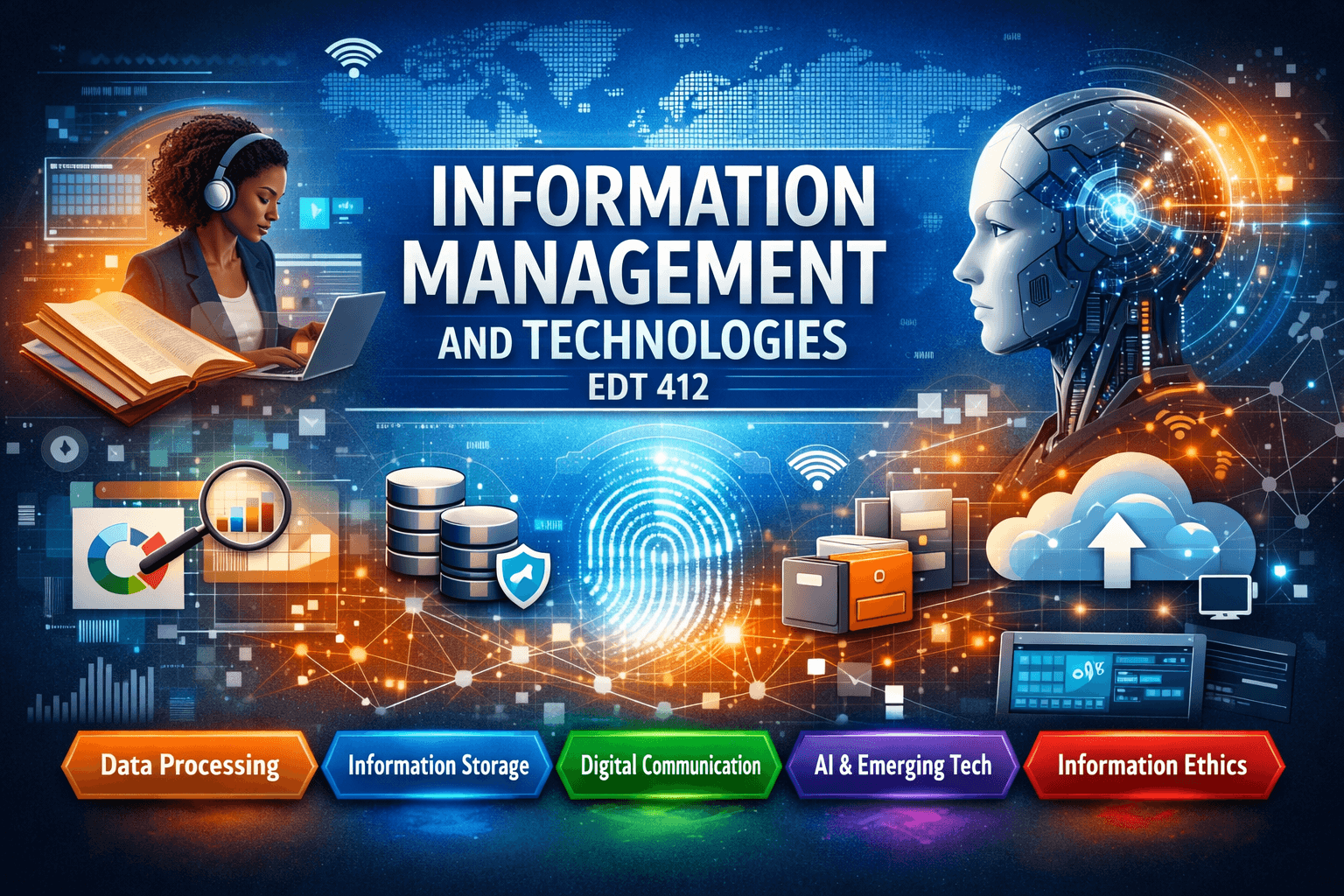
Information Management and Technologies (EDT 412) is an advanced course designed to provide students with a comprehensive understanding of how information is created, collected, processed, stored, transmitted, retrieved, and ethically managed in modern environments. The course equips learners with both theoretical knowledge and practical skills required to function effectively in today’s information-driven and technology-oriented world.
The course begins by introducing the fundamental concepts of data and information, emphasizing their differences and the critical role information plays in decision-making across education, business, healthcare, and governance. Students gain insight into the characteristics of good information and how information contributes to societal development.
A significant part of the course focuses on information gathering techniques, where students learn various methods of data collection such as observation, interviews, questionnaires, experiments, and focus group discussions. It also explores different sources of information—primary, secondary, and tertiary—highlighting their relevance in research and knowledge development.
The course further examines information processing, explaining how raw data is transformed into meaningful information through structured stages such as input, processing, output, and storage. Students are introduced to tools used in processing information, including manual, mechanical, and electronic systems, as well as the role of software and databases in enhancing efficiency.
In addition, the course covers information transmission, focusing on communication processes, channels (verbal, non-verbal, written, and digital), and barriers to effective communication. Students learn strategies to improve communication and ensure accurate dissemination of information.
The study of information storage systems exposes learners to both traditional methods (such as filing systems and paper records) and modern digital systems (such as cloud storage, databases, and network storage). This is complemented by the study of information retrieval systems, where students learn how to efficiently access stored information using both manual and digital approaches.
The course also explores the role of media in information management, including print and electronic media, and how they support communication, education, and information dissemination. Furthermore, it introduces photographic and reprographic systems, highlighting their importance in capturing, preserving, and reproducing information.
An essential component of the course is ethics in information management, where students examine issues such as privacy, data security, intellectual property, and professional standards. This ensures that learners understand the importance of responsible and lawful use of information.
Finally, the course addresses modern trends in information management, particularly digital transformation and the application of artificial intelligence. Students are introduced to emerging technologies that are reshaping how information is managed, accessed, and utilized globally.